Sunday, March 16, 2008
Suggestion to Jay Michael...
Announcement...
Video Shows Creepy Gnome: Bigfoot Like Sighting Terrifies Town
National Ledger - Apache Junction,AZ,USA
By Lynda Johnson It's not exactly Bigfoot, but it is a blurry sighting and video many believe that it might just be an urban legend. ...
See all stories on this topic
Exhibit unveils mythic creatures
Louisville Courier-Journal - Louisville,KY,USA
... Pegasus, the Sphinx, Bigfoot, Quetzalcoatl, giant roc birds and Mami Wata and her sister mermaids of all sorts from Africa to the Arctic. ...
See all stories on this topic
Squatch Detective Radio Tonight...
Review: The Sasquatch Experience 3-16-08
Review: The Bigfoot Mystery 3-16-08
Bill Green's Review of HBM's Crypto-Corner 3-16-08
hey henry bf2004 wow great show A+++ show about thunderbirds im sure it will be archived soon everyone. thanks bill

My next program, airing March 30th, is about Lake Monsters (Ogopogo, Cadobosaurus, Chessie, Champ and of course, Nessie) beginning at 5:00 EST/4:00 Central at http://www.blogtalkradio.com/HBMs-Crypto-Corner You can also find past episodes there, as well as subscribe on iTunes. My show will start going weekly in April, as well. And as always, we encourage you to please tune in and support great research.
Mysteries of the Oimyakon Baby Mammoth
Posted by: Loren Coleman on March 16th, 2008
Specialists of the Museum of Mammoth of the Institute of Applied Ecology of the North, Academy of Sciences of Sakha Republic (Yakutia), have been thoroughly studying a baby mammoth found in 2004 and they have published their first outcomes.
Investigate Further: Mysteries of the Oimyakon Baby Mammoth »
Bigfoot & Dranginis in the Classroom
Posted by: Loren Coleman on March 16th, 2008
Bigfooter William Dranginis of Manassas, Virginia, shares his experiences regarding times he has used Bigfoot in the classroom.
Investigate Further: Bigfoot & Dranginis in the Classroom »
Even MORE DVD Reviews Redux
This DVD is quite well-done by Don Keating, who interviews such witnesses and investigators as Linda Wygle, Chuck Storrie, Terry and Treba Jahn, Rod Zorger and Richard Myers about their experiences and sightings. The main focus is on an area known as "The Sasquatch Triangle", which encompasses parts of Coshocton, Ohio, Guernsey and Tuscarawas Counties in Eastern Ohio. The main coloration of the creature being seen in that area is a white individual. One of Don's earlier documentaries, "Ohio's Abominable Snowman?" is also included as bonus material, available for the first time on a mass-production DVD. An audio recording from September 1991 is also played of a possible vocalization. I do highly recommend this DVD for everyone's Cryptozoological DVD collection. Don continues to produce high-quality productions and wonderful information. The documentary can be ordered
Bill Green's Review: i just finished watching don keating new documentary dvd the mystery of the sasquatch triangle. it was very informative great it was like watching 2 documentarys in 1. the researchers interviews were great. there was a slight skeptical side to this documentary but that what made it great. don keating did a wonderful job narrateing this documentary. i realy liked how don & the researchers in this documentary actually showed the forests areas in ohio where the sasquatch creatures roam around. i give this documentary A++++. its definetly worth for any bigfoot dvd library. i realy liked how don talked about past ohio sightings as well. thanks bill green ct sasquatch researcher.i realy like how john horrigan also interviewed people in this documentary as well.
DVD Review: Eyes In The Dark: The Sasquatch Experience
This is a new documentary produced and directed by Todd Partain and his family, and it's a great one. It features Todd's story, as well as the testimonials of Bob Strain, Scott Herriott, Mike Hall and Richard Noll and their experiences. There are recreations (very professionally done) of each story, including the Skookum Cast incident. The recreation actor is also very good, the one in the Sasquatch costume. Dr. Linda Brent, a primatologist is also interviewed about her views on the Sasquatch phenomenon. It is quite a professional and well-done documentary, and highly-recommended. 5 out of 5 stars!!!!!!!!!!!!!!!!!!!!
DVD Review: On The Trail Of The Pacific Northwest Sasquatch
This nearly hour-long documentary profiles the Washington State Sasquatch Search Group in the field in the late-'90s in some truly beautiful country at the base of the Olympic Peninsula in Washington State. Researchers such as Andrew Peterson, George Kelley, John Pickering and Fred Bradshaw are out to find evidence of the hairy bipeds in the area, and one team member stumbles across some strange foot, hand and elbow prints near a muddy creek. They also find flattened-down trees and set out game cams as well to catch something, perhaps a Sasquatch, on film. They film all sorts of wildlife, such as elk, raccoons, bear, salamanders and birds, really giving the viewer an idea of the diverse animal life in the area. If nothing else, it gives the viewer a relaxing look into the Pacific Northwest and its beauty, and is really highly-recommended.
DVD Review: Bigfoot Lives
This documentary produced by Bigfooter Tom Biscardi, was actually quite well-done and much happened during the course of filming. The journey begins in Paris, Texas, where Tom and his team (Tommy Biscardi, Jr. Java Bob Schmalzbach and the Squatch Detective himself, Steve Kulls) come across some interesting tracks and they also have a sighting through a thermal imager of a large bipedal animal. The next location is Minnesota, where Don Monroe joins the group and they investigate sightings in the area and have more activity. Other locations include Arizona, New York State, Idaho and Montana. In Idaho, the mysterious "Hand of Unknown Origin" is discussed and determined to be-well, watch the DVD for your self to find out. In Montana, an unusual leg is discussed and a video is shown of it. All in all, this is one of the better docs I have seen recently.
DVD Review: Sasquatch Science: Searching For Bigfoot
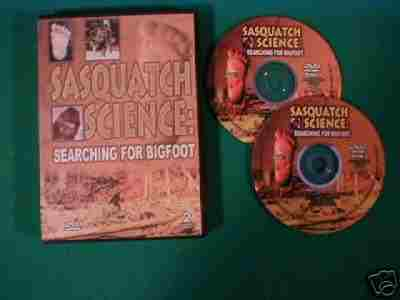
This two-disc DVD set features four lectures from an unknown location sometime in 2003, and the material is very interesting. Disc 1: The first lecturer, Dr. Jeff Meldrum of Idaho State University, is about footprint morphology, and is very well-done by Dr. Meldrum. After the lecture, he takes questions from the audience. Dr. John Bindernagel is next, with a history of the Sasquatch being left out of the field guides and also his feelings on the whole field and the rejection by science. He also takes questions from the audience. Disc 2: Gordon Strasenburgh, a longtime Bigfoot enthusiast, lectures on the Patterson/Gimlin film and why he thinks it's real and also his theory as to what Bigfoot is (he believes it's australopithecine). He also shows some native drawings and sculptures of apelike creatures from Native Americans. The last lecture is by John Green, the esteemed Sasquatch chronicler, who gives a history lesson of his involvement in it and also his descriptive nature of the creatures. This set is available at http://www.ufotv.com and is highly-recommended for anyone's Bigfoot DVD collection.
Review: "Giganto: The Real King Kong"
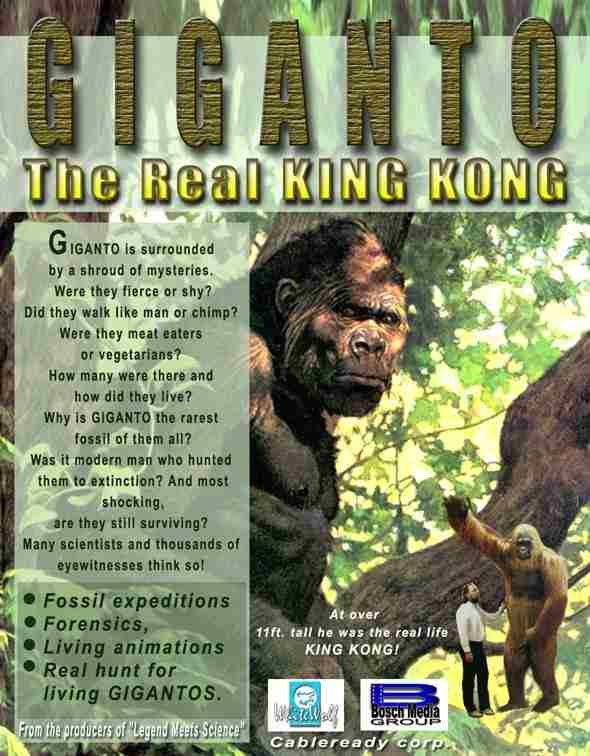
This special, produced by Doug Hajicek and Whitewolf Entertainment (the same folks behind "Sasquatch: Legend Meets Science") aired on the History Channel December 15th, 2005, and was really very well-done and well-researched. There was even a story on this special I didn't know about-Teddy Roosevelt apparently had a sound encounter with a creature unlike anything he'd ever heard before. I thought that was very interesting and unique, as the only connection Roosevelt had with Bigfoot was the Baumann story from "The Wilderness Hunter". This special explored the Gigantopithecus which existed millions of years ago and supposedly died out 100,000 years ago. However, some still believe it lives today (I am also of that opinion) as our modern-day Bigfoot or Sasquatch or Yeti. The origins of Giganto are explored, as well as the modern-day sightings. Several Bigfoot notables are interviewed, including Dr. Jeff Meldrum, Chris Murphy, Kathy Moskowitz-Strain and Richard Noll. Noted Giganto expert Dr. Russell Ciochon is also interviewed, and followed on a quest to find more Giganto teeth and bones in China; however, he discounts the idea of there being a modern-day Giganto still living today. He is, however, willing to search for bones of dead Gigantos, which makes one wonder why he does not put more effort into searching for live specimens. This special was very educational and was quite enjoyable to watch, and is coming to DVD for those interested in ordering it from the History Channel website. I highly recommend that purchase. This is a great and balanced documentary.
Review of The Sasquatch Odyssey DVD

A great documentary about the Grand Old Men of Bigfootery
I saw this documentary originally on video, presented as the original 70-minute documentary shown on television. This DVD, while it presents the original documentary, also has new segments, such as 3 short vignettes with Stan Winston (Aliens, Terminator 2) with him commenting that the Patterson/Gimlin film is most likely a brilliant hoax. There's a new question-and-answer segment with Bigfoot researcher Richard Noll in which he discusses his thoughts on Bigfoot and the Bigfoot field in general. It also shows him in the field finding a set of tracks. There is also a photo gallery featuring the four principles of the documentary. This documentary features the story of the four Grand Old Men of Bigfootery, John Green, Rene Dahinden, Peter Byrne and Grover Krantz, featuring classic footage of each man, which tells the story of each man's quest to find the Sasquatch. Two of the men (Krantz and Dahinden) have passed on since the filming of this documentary, but of the four, only Green continues to be semi-active in the hunt. Byrne is semi-retired and laregly out of the public spotlight. This documentary is highly recommended for those who want to know more about the personalities in the field of Bigfoot research.
DVD Review: The Legend Of Boggy Creek
Three Out Of Five Stars!!!
This quasidocumentary, originally released in 1973 and produced and directed by Charles B. Pierce, focuses on a Sasquatchlike creature in the Fouke, Arkansas area, a three-toed, 7-Foot tall, red-haired creature terrorizing the residents of the Fouke area, killing dogs, chickens, cows and other animals. The creature is apparently solitary, being the only one of its kind in the area. The creature is seen crossing roads and terrorizing residents in their homes, and of course is played by a guy in a suit. The creature seems to be faceless as well. Many of the real-life inhabitants of the town and area play themselves in the film, which is cheesy and somewhat dated, but still fun in its own way. Great film to watch on a dark night.
Review: The Patterson/Gimlin Film Revisited
This documentary, now available on http://www.cryptovideography.com as a free download (it is not available for purchase, but if you ask J. or M.K. to make a DVD copy of it for you, they will). This is a really great and in-depth documentary, looking into M.K.'s work (at the time of shooting, 6 years in) on the film, basically a sit-down interview by J. Michael for the first 40 minutes. The last 20 minutes show us M.K. going through different files and showing us various things in the film he has found. The last segment (and the most dramatic) has M.K.'s blown-up poster in his backyard, where he does accurate measurements on himself and on the creature and concludes it is Bigfoot and not a man in a costume. Very well-done early effort by J. Michael and Cryptovideography.
DVD Review: Bigfoot FAQ
And the hits just keep on comin'!
J. Michael's Cryptovideography has become a cottage industry of producing great documentaries without the usual "sneering skeptics" or loaded narration. This latest offering is really terrific and informative. J. goes through all the different questions that are asked about this subject and answers them with great aplomb and sober information. Such questions as "What is Bigfoot?", "How do we find them?", "Why do we have to shoot one?", "Is the Patterson/Gimlin film a fake?" and other questions are answered quite well and with scholarly precision. J. and Esther Schritter can be credited for the great cinematography as well as the production values, which are Hollywood quality. All in all, a great and balanced documentary. J.'s next project is another collaboration with Esther on the Bigfoot in Oklahoma. Great job as usual, J., and I look forward to more.
DVD Review: The Honey Island Swamp Monster
This is the second of J. Michael's documentaries on the southern Bigfoot, and it's a short but sweet one. Hosted by M.K. Davis, this documentary takes us to the Honey Island Swamp northeast of New Orleans, Louisiana to an area called Lock 1, where Harlan Ford and partner Billy Mills claimed to have had a sighting of a Sasquatch-like creature which was quickly dubbed the "Honey Island Swamp Monster." It supposedly left 3-toed tracks not too dissimilar to an alligator's. However, during the course of what was supposed to be a documentary on the legend of this creature, new information came to light which threw a large shadow of doubt over the whole story; a shoe with a flexible foot-casting was found near the camp of Harlan Ford which matches the supposed creature's casts perfectly. M.K. and J. had uncovered a hoax which had massive repercussions for the reality of the creature in the Honey Island Swamp. J. and M.K. learned that the shoe the foot-casting was attached to belonged to none other than Harlan Ford (or was the same kind of shoe he wore at least), which may indicate Ford was a hoaxer or someone stole his shoe to create the footprints. Whatever the case, the documentary does not close off the possibility of there being some sort of Sasquatch-type creature in the area, but the 3-toed tracks did turn out to be a hoax. This documentary can be picked up
DVD Review: Swamp Apes
Produced by: J. Michael Long
This 40-minute documentary showcases the history of Swamp Ape sightings in the southern United States, and it's a good one. J. Michael throws out several theories of the origins of the Swamp Apes, including the possibility that they might be generations of feral apes brought over to the U.S. by sailors and crews of ships. He also entertains the possibility of it being Gigantopithecus Blacki, and even throws out the theory that Bigfoot was always here and had possible meetings with apes. J. examines the terrain and country that these things live in and says that feral apes could adapt to life in the South easily, with a few modifications in their food-gathering and bipedal stance. The documentary is done very professionally and with great care, and is highly recommended. J. is selling it on e-bay, but he will have it available at
Review of "Sasquatch: Legend Meets Science" DVD

Director and producer: Doug Hajicek, Whitewolf Entertainment
I got this DVD in March of 2004, and watched it with great interest. The documentary was originally shown on the Discovery Channel in January 2003, but the DVD version has a little more material. The documentary itself examines the Patterson/Gimlin film, as well as Sasquatch physiology, anatomy, footprints, hair samples and the Skookum Cast body imprint. Also, a piece of videotape, known as the "Memorial Day footage", is examined, and a high-tech recreation is done of the video to determine if the subject of that film is running at a speed to fast for humans, or too slow. DNA is also examined, as are footprints and the dermal ridges in them. Scientists such as Dr. Jeff Meldrum, Dr. Daris Swindler, Dr. Esteban Sarmiento and Dr. John Bindernagel are interviewed on their impressions of the Sasquatch, as well as police officer Jimmy Chilcutt,former BFRO member Richard Noll, Dr. Robert Benson and several other luminaries. The DVD is excellent enough with this documentary, but it doesn't end there. The disc also has a Q & A from the BFRO, witness sighting statitistics and a photo slideshow. The best aspect of the DVD is 3 pieces of footage, shown in their entirety; the Patterson/Gimlin film (from John Green's copy), shown for the first time in crystal-clear clarity; the Paul Freeman footage of a Sasquatch walking from right to left into the woods and possibly picking up an infant; and the aforementioned "Memorial Day footage", which apparently shows near the end a protrusion on the creature, as if an infant had been placed on its shoulders. This DVD is available for $29.95 at www.bfro.net, and is highly recommended. It is the gold standard of Sasquatch Documentaries. An accompanying book is due this fall, as well as a sequel within the next year or so.
More DVD Reviews Redux


Jay Michael Hits Another One Out of the park!!!!!!
This DVD, professionally done and narrated by Jay Michael, is the story of Esther Schritter of Southeastern Oklahoma, describing several encounters she had as a child in Paine County, Oklahoma. She describes her first sighting when she was 3 or 4, while she was sitting in her highchair in her kitchen, seeing an ugly face come to the window; next she describes at age 12 she and a girlfriend going down to a frozen lake to slide on the lake and hearing a siren-type scream; at age 17, she was home alone and again saw a large creature which frightened her enough to retreat to the backdoor for the car and drive straight through her yard, with the creature seemingly in hot pursuit until she left the homestead. The focus next switches to some videotaped interviews Esther took with witnesses in Oregon and at the Honobia Bigfoot Festival in 2004 and other Oklahomans who describe strange vocalizations. A gentleman also seems to have found a possible hair sample, a rather large sample which he found in a tree. A sighting in the Arbuckle Mountains is also described by an eyewitness. A piece of footage of a footprint Esther found is also shown. Esther next discusses an encounter in Louisiana while she was a seismologist in which she and a friend appeared to have been parallelled by something in the woods near Arcadia, as well as a sighting of a large, bipedal creature retreating back into the woods. Esther, before she got in contact with other Bigfooters, had no other point of reference other than the classic film The Legend of Boggy Creek. More eyewitness accounts are shown as well, from Oklahoma and from the Pacific Northwest.
There also appears a videotape of something Esther caught on video on Timberghost's property, something large, dark and bipedal. You can e-mail Jay Michael at staff@cryptovideography.com for further information on ordering. There is also a bonus section after the closing credits from the Pacific Northwest with Don Monroe and some casts he has collected over his years of searching. There is also bonus material from the Bellingham, Washington Sasquatch Conference, as well as photos of casts from the PNW. The footage Esther took is also shown in enhanced form. I would say this is Jay's best effort yet. Bravo, Jay Michael!!!!!! 5 stars!!!!!! Get this DVD while you can!!!!!!
DVD Review: The 19th Annual Eastern Ohio Bigfoot Conference 2007
This event, held on Saturday, May 19th, 2007, featured speakers Tony Healy of Canberra, Australia, who discussed the Yowie phenomenon in the Land Down Under. His talk was a bit abbreviated on this DVD presentation, but we do get a feel for what he is looking into. The next speaker is Lorena C. from Camden, Ohio, who discusses the two sightings she has had close to her folks' property. Finally, filmmaker/producer Pat Holdbrook speaks about the film he produced based on M.K. Davis' work on the Patterson/Gimlin Movie, Bigfoot: An Encounter With Reality. Holdbrook also discusses his ongoing projects with One Step Beyond Reality, pertaining to Bigfoot, as well as more paranormal subjects. Healy and Holdbrook also take audience questions. The DVD ends with a question-and-answer session, as well as one lady coming up to give her eyewitness account. All in all, this is a really wonderful 2-hour presentation of a terrific Conference which gives a great insight to the research being done by independent investigators. I give this DVD 4 out of 5 stars. Excelsior, Don Keating!!!!!!!!!
DVD Review: Harry and The Hendersons

This is a wonderful DVD, really worth-purchasing. I only paid a grand total of $10.40 for it at Wal-Mart, and it's a great one. Great behind-the-scenes featurettes, an original theatrical trailer and a great transfer to DVD on Widescreen. The original review I wrote of it
DVD Review: Bigfoot: An Encounter With Reality
Bad Acting, but great research...
This docu-drama (combination documentary/dramatic presentation) was shot in late-2006/early-2007 and is the first production to exclusively feature the enhancements of M.K. Davis and Rick Noll on the P/G Movie, which are presented in interviews and a presentation on film. Researchers such as Don Keating, Lynda Wygle and Chuck Storrie are interviewed as well about their impressions of Bigfoot and the creature in the Patterson/Gimlin Movie. A Native American named Rainbow Eagle is also interviewed about the NA perspective of Sasquatch, as well as two psychics and their research. The acting leaves a bit to be desired, but the researchers, who basically play themselves, are excellent and really enhance the production. I would give this one 4 out of 5 stars.
Saturday, March 15, 2008
Sasquatch Experience Returns Tonight!!!!!!
Bigfoot Mystery this evening...
HBM's Crypto-Corner Today...
Bigfoot/Cryptozoology DVD Reviews Redux
Review: Ancient Mysteries: Bigfoot
 Great and fair assessment of the subject matter,
 DVD Review: East Coast Bigfoot Conference 2004
This 3-Disc set is chock-full of terrific presentations from top Bigfoot and Paranormal researchers, some from Pennsylvania, others from as far away as California. Eric Altman, the Pennsylvania Bigfoot Society Chairman, starts off the set with an overview of recent (at that time) activity in the Keystone State, featuring sightings and footprint finds, some of which are deemed hoaxes. Next, Daniel Perez gives an excellent presentation on the Patterson/Gimlin Movie, even inviting a 6'4" man up to attempt to duplicate "Patty's" walk (which the man attempts rather clumsily but does not measure up to the creature in the film). Rounding out Disc 1 are two short interviews with Perez and Altman, as well as a photo presentation of investigations by the PBS and Pennsylvania Researchers Organization (PRO) into different hotspots of activity. Disc 2 has two excellent presentations, first one by Bigfoot/Paranormal researcher Travis McHenry, who explains that he is not of the opinion that Bigfoot is paranormal, but believes people may be seeing ghosts of Bigfoot in SOME cases, and also that Bigfoot is not necessarily connected to UFOs just because a person sees a BF coming out of a spacecraft. Mike Frizzell of the Enigma Project gives an excellent presentation on some investigations he and his group conducted into activity in New Jersey and Georgia, the Georgia activity taking place over 40 years ago. William Dranginis is shown next giving a tour of his Bigfoot RV and the equipment he uses in the field. Disc 2 rounds out with interviews with McHenry and Frizzell and a photo gallery of the Conference. Disc 3 has two excellent presentations on ghosts by Rick Fisher and Rosemary Ellen Guiley, interviews with the two of them and the trailer for the DVD. The entire set is professionally done from top to bottom, absolutely top-notch, and all the speakers are clear and concise. Craig Hines did an absolutely excellent job on this entire set, and should be commended. EXCELSIOR!!!!!!
DVD Review: Spotlight on The Patterson/Gimlin Film: The M.K. Davis Theory

This documentary, produced by John Johnsen (Keeping The Watch) and M.K. Davis is very well-produced and professionally done. The first 10-15 minutes is devoted to different film stocks and the resolution which can come from each. Chromatic Aberration is also discussed. The theories and enhancements of Davis are shown next, with full explanations as to all of them, such as the humanness of the creature, humanlike lips, the explanation for the alleged saggital crest and other theoretical assessments on the possible humanity of "Patty." There is also a possibility of more than one creature being seen in the film as well. The historical perspective and possible origins of the Pacific Northwest Bigfoot is also discussed. M.K. also reads the preamble to his upcoming book he is writing on these theories and the history behind them. I do recommend this documentary if for nothing else, as a conversation piece. I would give it 3 1/2 out of four stars.
DVD Review: Keeping the Watch

This documentary is about six independent researchers, and it's a good one. John L. Johnsen interviews, edits, produces and directs this hour-long documentary, which follows Dan Jackson of Florida, former researcher, talking about his foray into Skunk Ape research (he is now retired from research due to a terrifying experience he had with a creature); M.K. Davis of Mississippi is profiled next, discussing his groundbreaking work into the Patterson/Gimlin film; Chanda (no last name) discusses her habituation research in Missouri, which seems to be controversial to some, but may be credible; Carol Solomon, also of Florida, who describes a dead cow she found which the buzzards wouldn't touch, as well as strange tree and grass formations she has found in her area; David Shealy of Florida, controversial researcher (and possible hoaxer) discusses his activity and research into the Skunk Ape. Lloyd Pye is interviewed last, regarding hominoids such as Bigfoot, Yeti, Almas and other mystery primates all around the world. He gives his uncensored opinions of these events. This is a well-done and well-researched documentary, and well-worth purchasing. It can be purchased at
Grendel FilmsDVD Review: Hunt The Dogman

This is a truly creepy, unusual and well-done documentary, from John Johnsen and Grendel Films (Keeping The Watch, Spotlight On The Patterson/Gimlin Film: The M.K. Davis Theory). It begins with a look at a property where a house once stood in the state of Kentucky, which was the residence of Dogman researcher Barton Nunnelly, who tells of sightings of hairy creatures and black panthers in the area. It switches next to an interview with Bart's mother, Rose Jenkins, who describes some encounters she has had with a large half-man, half-dog creature, including a sighting she had through her window as a girl where she saw a creature with a white shirt on. Next, an individual only known as "Roy" is given an extensive interview in which he describes encounters he has had with the unusual creature, including a heart attack and near-death experience he had. He also says he saw a portal of some sort which the creatures could travel in and out of between dimensions, and also claims that the creatures communicated with him telepathically. Next, famed Dogman researcher Linda Godfrey is interviewed about her impressions of these beasts in Wisconsin and Michigan, as well as Texas, Alabama, Florida and other states. Next, a piece of footage known as the "Gable FIlm" is shown and examined, and is apparently being examined by M.K. Davis, who is extremely disturbed by it according to Johnsen. The film shows a large doglike individual running towards the cameraman, and we see a set of canine teeth bite down on the camera lens. The film is in the hands of an individual named Steve Cook, who has declared it a hoax. Next, an individual named Jan Thompson is interviewed about her encounters at Land Between The Lakes, also in the Bluegrass State, as well as a mysterious murder of an entire family in the area which allegedly took place in the early-'80's. Finally, night footage of a stakeout is shown, with no results. This is a very top-notch documentary, and carries on in the tradition of Johnsen's other two documentaries. I give this one 4 1/2 out of 5 stars.
DVD Review: The Legend of The Honey Island Swamp Monster
This documentary, produced by author Dana Holyfield, granddaughter of Harlan Ford, who claimed to have seen a mysterious creature in the Honey Island Swamp area of Louisiana, is a good assessment of the activity going on in that area. There are several eyewitness accounts given, as well as track discoveries which take place during filming. Lloyd Pye is also interviewed giving his opinions and assessments of what the creature could be and also his opinion of one of the track casts, and also there is a visit to Ricky Hollifield (no relation) who shows the shoe that he showed to M.K. Davis and Jay Michael when they shot their documentary, but Holyfield points out that the casts she has are larger than the resin cast maker. Near the end of the documentary, there is a hunt for the creature in which we can hear it seemingly screaming, and a group of teens are partying with loud music going when they hear the screaming and decide to beat feet. Within the last few minutes of the documentary, a piece of film is shown of what could be the creature, but it is behind a grove of trees so it is really hard to tell. There is an enhancement shown of the film as well, but it sadly is no clearer. I would give this one oh, about a 4 out of 5 stars. I liked it.
DVD Review: Western Bigfoot Society Meeting 1992 with Peter Byrne
DVD Review: "Shaawanoki: The "Skunk Ape-Florida's Bigfoot"
This DVD documentary is very interesting and unique in that it focuses on the Florida version of Bigfoot, a creature the local Seminole Indians call "Shaawanoki" ("man of the swamps"). Interestingly enough, the local tribe does not believe in the Shaawanoki or that it exists! Peter Byrne, former big-game hunter and world-renowned Bigfoot pursuer, takes us through the swamps of Southern Florida, giving us a view of the truly primitive and desolate country that the Shaawanoki calls home. A series of photos taken by a British tourist allegedly of the creature is examined, and determined by Byrne's analysis to be a hoax, a man in a gorilla costume. However, a photo taken by former fire chief Vince Doerr seems to have some validity in Byrne's mind. We get a good glimpse of the local wildlife and also of Byrne's efforts to locate this creature, even though he has limited knowledge of the area or the creature. There are also interviews with witnesses of the creature. Byrne, Roseman, Wallach and two others, re-enacting the Shaawanoki in ape suits (Rara, Peter's daughter and longtime Bigfoot enthusiast Larry Lund) really give the documentary a comfortable and professional feel, and they are all to be commended. I highly recommend this DVD to all Bigfoot enthusiasts. It can be purchased at http://www.shaawanoki.com
Pinky Expedition: High Walking
Posted by: Loren Coleman on March 15th, 2008
In the quest for cryptids, what mundane observations may have been converted into the extraordinary? What is the role of crocodilians in any confusion with Pinky? Photos.
Investigate Further: Pinky Expedition: High Walking »
Rebsamen Tribute: Scott T. Norman
Posted by: Loren Coleman on March 15th, 2008
Bill’s tribute on Scott’s birthday. Cryptomundo exclusive painting.
Investigate Further: Rebsamen Tribute: Scott T. Norman »
Happy Birthday, Scott T. Norman
Posted by: Loren Coleman on March 15th, 2008
 Celebrating a good life, in the midst of so much that is not. Photos.
Investigate Further: Happy Birthday, Scott T. Norman »
"Sole Pads and Dermatogyphics of The Elk Wallow Footprints"
ABSTRACT: Sasquatch footprint casts from Elk Wallow (Walla Walla), previously examined in detail by Krantz (1983), are discussed with respect to the presence of a large sole pad. A sole pad is an important component in locomotion, and reconstructions of anatomy and gait must take it into account. Because large animals compensate for heavy weight principally through locomotor pattern, a large, unknown biped need not have enormous stresses acting on the moving lower limbs, but would have a gait different from living bipedal hominids. Anatomical reconstructions must also take this into account. Dermatoglyphic evidence, if abundant, can be used to reconstruct behavior. Hence, it is possible that future research utilizing prints and track ways of these large, unknown animals in the Pacific Northwest may yield more information about locomotion and behavior than is presently the case, if investigators are willing to entertain the possibility that the animals responsible for the prints may be unlike any known mammal in anatomy and locomotion. Krantz's (1983) identification of the prints as hominid, by virtue of an adducted hallux, is questioned.
INTRODUCTION
In his recent paper on the Elk Wallow (Walla Walla) Sasquatch footprints, Krantz (1983) presents a detailed summary of the configurations of three footprint casts, paying particularly close attention to dermatoglyphic data. Skepticism as to whether dermatoglyphic patterns can be preserved on plaster casts is answered by Krantz's experimental proof that a human thumbprint can be transferred from skin to soil to plaster, and by the fact that criminal identification by dermatoglyphics from footprints imprinted in soil is acceptable procedure by police departments in two countries. Krantz then investigates the dermatoglyphic patterns of the casts, and concludes from this evidence that the makers of the prints were primates. Krantz further identifies the Elk Wallow prints as made by a specific category of primates, hominids (Krantz 1983: 53)--that is, members of the zoological family to which living humans and their extinct relatives belong.
In this paper, I shall examine the sole pad, a feature of the Elk Wallow prints, which Krantz does not discuss in as much detail as the dermatoglyphic evidence. This feature is, however, important for reconstructing anatomy and locomotion. I shall also examine the influence of body size on locomotion, and indicate some ways in which dermatoglyphic evidence, if more abundant, may be used to reconstruct elements of behavior. I conclude by stressing the probability that the makers of the Elk Wallow prints are unique among mammals in terms of anatomy and locomotion, and that identification of the prints as hominid in origin, on the basis of a single trait (an adducted hallux), is incorrect.
THE SOLE PAD
One of the striking morphological features documented by the casts is the apparent presence of an extremely thick, flexible pad on the sole of the Elk Wallow feet. Given the impression of a stone in the middle of the "full right" cast, and a photograph of the actual print with stone in place, Krantz (1983: 64) estimates the minimal thickness of this pad as slightly greater than 2 cm in the middle of the sole. Anatomical evidence from the gorilla, largest of the living primates, indicates that a sole pad can exist with dermatoglyphic patterns intact on the plantar surface. It is therefore possible for a very large mammal to possess a thick, flexible sole pad with dermatoglyphics, and not merely ridged skin.
One might assume, by analogy with living mammals possessing such pads (Morton 1935), that the sole pad of an unknown mammal would be composed of fat and tough, fibrous connective tissue. The thick, fibrous strands would bind the skin to the deep fascia (plantar aponeurosis), and would form small compartments of firm and resilient fat. The depth of the pad might vary along the foot according to weight-bearing considerations. A sole pad is therefore a biologically normal structure, and one can use evidence from living mammals to infer its general composition in a form whose anatomy is unknown. Is it possible to estimate the depth of the sole pad in the Elk Wallow creatures using available information on sole pad thickness in living mammals? Such information exists for two primate species, gorillas and hominids.
Fat and connective tissue comprise the sole pad in the gorilla. Thick skin covers the sole of the foot, and is underlain by fat and fibrous tissue at the lateral border of the foot. The depth of this pad increases posteriorly, and reaches a maximum depth of 2.5 cm under the heel (Raven 1950: 71). In modern, bipedal humans, the sole pad is an important weight-beating structure which is so compressible and shock-absorbing that a fall directly on the heel which shatters the calcaneus may leave no mark on the sole pad (Klenerman et al. 1976). The skin on the sole is thickened, especially at the heel, even in human fetuses, but the skin and the underlying pad of lobulated fat and collagen fibers is also subject to some variation in depth. Certain congenital diseases, accidents which result in the foot being placed in a cast, or prolonged bed rest may cause such thinning of the sole pad that walking is almost impossible. In acromegaly, this sole pad becomes very much thicker than normal, sometimes achieving a state "like a built-in layer of crepe rubber" (Klenerman et al. 1976: 137). Data on the average thickness of the human sole pad at the heel region do not seem to be readily available. In dissections of cadavers, the skin of the sole is so thick and firmly bound to the underlying lobulated fat that it is difficult to disclose the plantar aponeurosis; I would estimate a thickness of about 2 cm in the human cadaver. Histological study of the subcutaneous tissue of the gorilla foot seems to indicate a composition and thickness similar to that of man (Straus 1950: 217). An average greatest sole pad thickness of 2.5 cm may therefore be nearer the modem human norm.
Note that the sole pad is about the same thickness in hominids and gorillas, although gorilla weight is approximately three times that of hominids. I now make two assumptions. First, I assume that bipedal locomotion, in which all of the body weight is supported by the hind limbs, experiences more selection pressure for cushioning of the foot than is the case in quadrupedal locomotion. The thickness of the sole pad in the quadrupedal, knuckle-walking gorilla would therefore be increased in a biped of gorilla size. Professional human runners, who experience impact forces at heel strike of three to five times that experienced during walking (Roy and Irvin 1983: 422), are forced to control foot movement and absorb shock with specially constructed shoes and orthotic devices. In effect, they must create artificial sole pads in addition to the natural cushioning of the sole, and even then cushioning is not always adequate to prevent injury in running athletes. This is especially the case in marathon running, where impact forces acting over a distance often cause overuse injuries. Running bipedal hominids thus experience foot impact forces several times that experienced during walking, and often suffer as a result of inadequate natural sole pads, which have been evolved to withstand walking impact. I believe that this demonstrates that, if bipedal hominid body weight were multiplied several times--the equivalent of the increase in impact force experienced during running--the thickness of the sole pad would be correspondingly increased to ensure efficient bipedal walking. In short, if gorillas were bipeds instead of quadrupeds, their average greatest sole pad thickness would perhaps be about 6-7.5 cm. I also assume that the cushioning efficiency of the sole pad in walking modem hominids is at or near the biomechanical optimum for a bipedal mammal.
If the ankle of the Elk Wallow creatures were set farther forward on the foot than is the case in modem hominids (Krantz 1983: 60), the greatest thickness of the sole pad might occur closer to the front of the foot, and not at the heel, as is the case in gorillas and hominids. The exact position of this maximum thickness would depend on the manner in which the foot contacts the substrate--that is, whether the heel or the forward part of the foot contacts the ground first (or perhaps the entire sole contacts the ground at once). It is possible therefore, that Krantz has greatly underestimated the thickness of the pad at the middle of the sole, perhaps close to where its greatest thickness would occur. If the average thickness of the sole pad is about 2-2.5 cm in the heel region of modern bipedal hominids with a mean weight of 60 kg (Eisenberg 1981), then it is not unreasonable to reconstruct the pad on the sole of the Elk Wallow creatures as being between 10-15 cm at its greatest thickness, if these creatures are bipedal and have a weight of 400 kg, as Krantz estimates. I am simply multiplying the thickness of the hominid sole pad by six to achieve a similar kind of cushioning efficiency in an unknown bipedal mammal whose body weight may be six times greater than that of hominids. Again, this reconstruction assumes that the cushioning efficiency of the sole pad in modern hominids is at or near the biomechanical optimum for bipedal mammals. Details imprinted on the side of the Elk Wallow prints and the edges of the footprint indentations themselves indicate that an extremely flexible sole pad is present (Krantz 1983: 64-65).
A question now presents itself. If the Elk Wallow sole pad should have a thickness of 1 0-15 cm at its greatest depth, and should be extremely flexible, then what is the likelihood of the prints themselves preserving an extremely detailed record of anatomy and locomotion? Would not the collapse of the sidewalls of the print impressions as the foot is withdrawn obscure fine details? The print impressions would be wider at the bottom than the top, and would be subject to such collapse. Some record of wider span at the bottom seems to be preserved in the Elk Wallow prints. Slight movements of the flexible tissue of the sole would tend to erase details, even if collapse of soil at the edges of the prints did not occur. It might be that, as body weight causes compression of the sole pad, the foot would expand and extend laterally. Analysis of gait would be incomplete or inaccurate if it did not allow for these lateral shifts, which would significantly broaden the print. Very detailed analysis of locomotion by examination of footprints to yield evidence of the sequence of weight transfer (Napier 1973), and taxonomic assignation by fine examination of dermatoglyphics might therefore be subject to a certain margin of error. Only under exceptional conditions would the substrate be able to preserve an accurate picture of the living foot. The fine-grained loess soil at the Elk Wallow site may represent such conditions, but this is not the case for most areas in which prints of creatures like those presumably responsible for these prints have been collected and studied.
Another question concerns the depth of the prints themselves. If body weight is supported by such a sole pad, the large surface area of the sole would spread the weight over a relatively wide area, so that only faint tracks would be left on hard ground. In the elephant, for example, the cushioning sole pad is so thick that the foot has an externally plantigrade appearance, although the foot skeleton is held in a semi-digitigrade position. That is, the elephant's heel appears externally to be touching the ground, but the animal is actually walking with the heel portion of its foot skeleton raised. The large, thick ~ole pad allows the animal to traverse extremely rough terrain and move silently, but the sole pad also spreads the great body weight so efficiently that individual tracks, although they cover a large area, are fainter than one might assume from the known body weight. Sikes (1971: Plate 8) shows the prints of one African elephant in firm, sandy soil. Although the print of one foot overlies the other print, pressing the soil down twice, the impressions are rather shallow. If a large sole pad spreads even massive body weight so efficiently, why do the Elk Wallow prints appear so deep? It is unlikely that the body weight exceeds the estimated 400 kg, and the sediment does not seem to have been very soft. It is possible that the sole pad of the Elk Wallow creatures is not as efficient as that of the elephant at distributing body weight over a large surface, but some type of sole pad does seem to have been present, and the estimate of its greatest depth is based on the weight inferred by Krantz (1983).
I am reasonably certain that the Elk Wallow prints are authentic. However, I do have reservations about the prints recording a precise and accurate picture of details of weight transfer. While certain portions of the casts show remarkably fine structures, Krantz (1983) is forced to select small areas from the casts to discuss dermatoglyphic evidence. This would appear to indicate that the flexible sole tissue is erasing detail. I am also puzzled by the depth of the prints. Perhaps experimentation with an artificial sole pad which could mimic the texture of the thick sole pad tissue in such mammals as camelids and elephants might resolve how much known detail can be reliably transferred from such a device onto loess soil, and thence onto plaster, and whether the dynamics of locomotion can be inferred from print and cast. The question of the depth of print impressions in relation to body weight might also be examined, if the device were capable of dissipating load like living tissue.
If the question of the depth of the impressions can be answered, the likelihood that the Elk Wallow creatures possess a large sole pad could lead to new insights into the anatomy and locomotion of such unknown animals. One interesting possibility is that the Elk Wallow creatures, like elephants, might have a semi-digitigrade foot skeleton, although the large cushioning sole pad would give the external foot a plantigrade appearance. This might account for the great amount of weight apparently carried on the forepart of the foot. Rotational movement at the ankle joint would be lost, however, so that envisioning an enlarged version of a hominid subtalar joint, for example, would be incorrect. Although Krantz (1977) has argued that the digits of the Sasquatch foot are short for biomechanical reasons, the short visible part of the digits might be arrayed at the forward edge of the sole pad, and their true length be obscured by the structure of the pad. The hind limb anatomy and gait of the Elk Wallow creatures may be unique among mammals, and not easily inferred from comparison with living mammals of a single order, even if the dermatoglyphic evidence points to the primates.
Finally, as Napier (1973) has stressed, track ways of animals, and not single isolated prints, are necessary for detailed analysis of gait. Future researchers should be prepared to make casts of partial track ways--obviously not an easy task.
BODY SIZE AND LOCOMOTION
Sasquatch foot anatomy has been examined in detail by Krantz (1977), who argues that, in comparison with living hominids, these creatures have a lengthened heel and a shortened forefoot. This leads to a reconstruction in which the ankle joint is set farther forward on the foot, a point which is also made in Krantz (1983). The power arm of the foot is thereby lengthened and the load arm is shortened. This reconstruction is derived from Krantz's belief that changing the length of the lever arms in the foot is the simplest evolutionary solution to the problem posed by large body size in bipeds. Large body size creates a problem if body weight increases cubically, while skeletal dimensions increase areally. Hence, Krantz proposes that allometric or size-related considerations affect body design in bipeds, which are significantly larger than modern hominids.
Recent research on the allometry of mammalian limb bones, however, demonstrates that the lengths and diameters of limb bones in a series of species stretching from shrew to elephant-size scale close to geometric similarity (Alexander et al. 1979a). Obviously, there are tremendous differences in adult body mass, but the linear dimensions of the limb bones in the series are geometrically similar. For example, the elephant femur and humerus are not very much wider relative to their length than in much smaller animals. This surprising conclusion--which upsets statements on the allometric relationship between limb bone dimensions and body weight going back to the time of Galileo--also holds true within the primates, because six primate species (including modern hominids) are included in the mammalian survey (Alexander et al. 1979a). This research implies that the limb bones of a biped much larger than a modern hominid need not be strikingly different in form in order to support a much greater body weight.
Stresses on limb bones of moving animals versus stationary animals have also been examined (Alexander 1977, Alexander et al. 1979b). Because movement causes several times more stress on the limb bones than does standing still, the increase of limb bone diameter in step with length increase becomes even more surprising. How do large animals exist in spite of what appears to be a biomechanical paradox? The answer lies in gait differences. Movement patterns of different sized mammals demonstrate that the large mammals move in such a way that their limbs remain in contact with the ground for a longer time, which decreases stress in the limb bones. The reduction of relative stresses in these bones compensates for greater body weight. The maximum stresses acting on the limbs of large animals are comparable to those of smaller animals, so that the bones of the larger species do not need to be much more robust (Alexander 1977, Alexander et al. 1979b).
Two conclusions can be drawn from this research. The first is that unknown bipedal animals much larger than modern hominids, but hominid-like in position of the trunk and use of a striding gait in locomotion, are not an a priori impossibility. The second conclusion is that, because large animals compensate for heavy bodies mainly through gait pattern, differences between large, unknown bipeds and hominids might lie in the amount and length of time of foot contact with the ground, rather than in gross differences in skeletal structure.
DERMATOGLYPHICS AND THE RECONSTRUCTION OF BEHAVIOR
Dermatoglyphic evidence from the Elk Wallow prints is necessarily confined at present to description and taxonomic assignation. Nevertheless, it is possible that, if such evidence were to become more abundant in the future, details of behavior might be reconstructed from dermatoglyphic evidence. Primate species can be used to illustrate this contention.
There is a substantial body of data on the volar skin and dermatoglyphics of primates. Cartmill (1974, 1979) demonstrated that volar skin was subject to selection pressure involving allometry, with volar pad coalescence occurring in larger primates as an adaptation to increase its frictional characteristics. Biegert (1963) advocated the use of primate dermatoglyphics and volar pad structure as taxonomic traits, and in the reconstruction of phylogeny, but Meier (1980) reported evidence that dermatoglyphic pattern intensity in non-human primates may be more related to function than it is to taxonomy or phylogeny. The use of dermatoglyphics as indicators of biological distance in humans has equivocal results, which do not necessarily coincide with biochemical or anthropometrical variation (Meier 1980). This may not be the case in non-human primate species.
Dermatoglyphics appear to be useful in identifying individual animals, demonstrating group cohesiveness, and allowing analysis of introgressive hybridization in an Ethiopian site with troops of both olive and hamadryas baboons, and a troop of hybrids of these two species (Jolly and Peterson 1984). Analysis of dermatoglyphics in mantled howler monkeys on Barro Colorado Island, Panama, allowed inferences to be made about the evolutionary history of these monkeys on the island (Froehlich and Thorington 1982). Inferences about the colonization of one of the peninsulas by two different howler troops, and the differentiation of neighboring troops from a common troop are based on dermatoglyphic analysis. Thus, dermatoglyphic evidence can be used not simply for taxonomic or phylogenetic purposes, but for social and historical reconstruction as well. If the Elk Wallow prints and associated dermatoglyphics hold up under detailed scrutiny, and if many additional prints with dermatoglyphics are found, the possibility exists that the genetic relatedness of individuals can be assessed, along with the possibility of differentiating variation at a group level, allowing inferences about the existence of social groups, gene flow, and the process of dispersal of groups or individuals within a given habitat unit.
CONCLUSION
There is a reasonable probability that the Elk Wallow prints were made by an unknown animal species. I have examined the presence of a large sole pad in some detail, and have reconstructed a sole pad whose greatest depth would approximate 10-15 cm. Two problems still concern me: 1) the degree to which the prints preserve undistorted information about dermatoglyphic pattern and locomotion, and 2) the depth of the print impressions, in spite of the presence of a sole pad which should efficiently distribute body weight.
I have also discussed the interaction of body weight and locomotion, and have indicated that, because large animals compensate for great weight mainly through gait pattern, gross differences in skeletal structure between large unknown bipeds and modern hominids are not necessarily to be expected. A larger biped would, however, need a greater length of time of foot contact with the ground. Furthermore, unknown bipedal animals much larger than modern hominids, but hominid-like in trunk position and use of a striding gait, are not intrinsically impossible.
If dermatoglyphic evidence similar to that from the Elk Wallow prints were to become more abundant, behavioral reconstruction could be attempted, given the lines of behavioral research that have opened recently from dermatoglyphic research in primates.
Finally, I question Krantz's identification of the Elk Wallow prints as "hominid," by virtue of the marked adduction of digit I (Krantz 1983: 53). Living primates show many variations in extremity structure. For example, New World ateline and Old World colobine monkeys independently reduced digit I in the hand, sometimes to a remarkable degree. This would be an example of the parallel evolution of a trait in two different infraorders of living primates. Conversely, it is also possible for members of a single family to show remarkable divergence in extremity structure. Thus, the African great apes develop knuckle-walking specializations of the hands while the orang-utan does not, instead lengthening the entire hand and digits II-V and reducing digit I. The foot of the orang-utan is similarly lengthened, with concomitant elongation of digits II-V, and reduction of digit I, sometimes to a vestigial state. Given the great evolutionary potential for variation in extremity structure documented in living primates, it may be problematic to identify the Elk Wallow creatures as hominids by virtue of a markedly adducted hallux. In any case, Krantz also lists a number of traits, which completely differentiate the Elk Wallow prints from those of modern or extinct hominids, such as the anterior placement of the ankle and extremely short digits. Although reported sightings of these animals emphasize similarities to hominids, and dermatoglyphic evidence points to the primate order, analysis of the prints demonstrates the existence of foot structure and locomotion unlike anything known among mammals. The prints are not simply enlarged and broadened versions of hominid prints. Therefore, the makers of the prints do not have the anatomy, body proportions, and locomotion of living hominids.
REFERENCES CITED
Alexander, Robert McN.
1977 Allometry of the Limbs of Antelopes (Bovidae). Journal of Zoology, London, Vol. 183: 125-46.
Alexander, Robert McN., A. S. Jayes, G. M. O. Maloiy, and E. M. Wathuta
1979a Allometry of the Limb Bones of Mammals from Shrews (Sorex) to Elephant (Loxodonta). Journal of Zoology, London, Vol. 189: 305-14.
Alexander, Robert McN., G. M. O. Maloiy, B. Hunter, A. S. Jayes, and J. Nturibi
1979b Mechanical Stresses in Fast Locomotion in Buffalo (Syncerus caffer) and Elephant (Loxodonta africana). Journal of Zoology, London, Vol. 189:135-44.
Biegert, Josef
1963 The Evolution of Characteristics of the Skull, Hands, and Feet for Primate Taxonomy. In Sherwood L. Washburn (ed.), Classification and Human Evolution. Chicago: Aldine.
Cartmill, Matt
1974 Pads and Claws in Arboreal Locomotion. In Farish A. Jenkins (ed.), Primate Locomotion. New York: Academic Press.
1979 The Volar Skin of Primates: Its Frictional Characteristics and their Functional Significance. American Journal of Physical Anthropology, Vol. 50:497-510.
Eisenberg, John
1981 The Mammalian Radiations. Chicago: University of Chicago Press.
Froehlich, Jeffry W., and Richard W. Thorington
1982 The Genetic Structure and Socioecology of Howler Monkeys (Alouatta palliata) on Barro Colorado Island. In Egbert G. Leigh, A. S. Rand, and Donald M. Windsor (eds.), The Ecology ora Tropical Forest. Seasonal Rhythms and Long-Term Changes. Washington, D.C.: Smithsonian Institution Press.
Jolly, Clifford J., and A. K. Peterson
1984 Variation in the Palmar Dermatoglyphics of Ethiopian Baboons. American Journal of Physical Anthropology, Vol. 63:175-76 (abstract).
Klenerman, L., et al.
1976 Common Causes of Pain in the Region of the Foot. In L. Klenerman (ed.), The Foot and Its Disorders. Oxford: Blackwell Scientific Publications.
Krantz, Grover S.
1977 Anatomy of the Sasquatch Foot. In Roderick Sprague and Grover S. Krantz (eds.), The Scientist Looks at the Sasquatch. Anthropological Monographs of the University of Idaho no. 3. Moscow, Idaho: University Press of Idaho.
1983 Anatomy and Dermatoglyphics of Three Sasquatch Footprints. Cryptozoology, Vol. 2: 53-81.
© Susan Cachel, Department of Anthropology, Rutgers University 1985
********
There are also some small images I have of sections of each cast.


Editorials Redux Part 2
A lot of the time, many researchers have their own thoughts about certain individuals in the field of Bigfoot research. But sometimes people get swayed very easily by others in the field and form their opinions based on others' opinions rather than their own thoughts and opinions. I have fallen into this trap, unfortunately. Well, that is OVER for me. How much time have I wasted psychoanalyzing people and saying "so-and-so did this, so-and-so said that?", and most of the time these opinions have been based on what others have said about so-and-so. This is time I could've spent getting to know certain individuals in the field instead of being so jealous and back-biting and bitter about certain people. I admit, I have fallen into the trap of letting others determine my opinions on certain individuals in the field, and I need to stop being swayed by what Joe Blow said about John Doe and have my own damn opinions on people. That kind of crap is rumor-mongering and gossip and it has got to stop. We are ALL in this together to try to solve this, so who gives a crap if it is John Doe or Joe Blow that solves it, as long as it is solved? I would encourage others to do the same as I have, and quit being swayed by what is said on this forum or that messageboard or in some chatroom and form your own opinion on someone, good or bad. I am not saying you have to like certain individuals in this field, but for God's sake, stop all the back-biting and rumor-mongering and bitterness, and let us all work TOGETHER as a unit to solve this mystery. Billy Willard made a good point to me in a chatroom last night when he said that we can't get to know someone through a computer screen, and he is absolutely right. If we spent half as much time in the field actually LOOKING for evidence as we do sitting anonymously behind our computer screens tearing others down, we would be in a boat in the middle of Loch Ness by now!!!!!!
Editorial: Why so much in-fighting?
Something that has plagued the Bigfoot community for years is something only as simple as ego. In-fighting, jealousy, back-biting, vicious attacks on others. I have one question for this-why? Aren't we all supposed to work together? Aren't we supposed to work as a community and stop all the back-biting and in-fighting? Obviously not, as there is so much ego and jealousy in this field. Researchers even go so far as to spread unconfirmed rumors about others, more particularly if they have a vendetta against each other. It's no wonder that after nearly 50 years, a specimen has yet to be brought in and confirmation of the species has yet to occur. What people need to do is set aside their differences and try to work together to solve this mystery. It is sickening to see the "He said, she said" BS permeate this field as it does, and we all need to realize we have more in common than we have different. C'mon, Bigfooters, let's cooperate to solve this mystery!
Editorials Redux...
Editorial: Should we be neutral on Tom Biscardi?
I can already predict I will take some heat for this editorial, but I am willing to take it anyway. I have a neutral stance on Tom Biscardi because I do not know the man, so I cannot say whether or not he is a hoaxer or an alleged hoaxer or a fraud or whatever. Sure, most of the Bigfoot Community has their own opinions on Mr. Biscardi, but some people go against the grain and have a neutral stance on him until they meet him. Some like myself have decided to make up our own minds about Biscardi rather than following along with the rest of the Bigfoot Community. Of course, what happens when a credible researcher associates with Biscardi or goes on his radio show is, most of the Bigfooters jump on the person that decided to associate with Biscardi or say that person is a sell-out. That is utterly ridiculous and absolutely unprofessional. People choose to associate with Biscardi or go on his radio show to get out the message of Bigfoot, not because it's the Tom Biscardi show. Why don't certain individuals in the BF Community let others make up their own minds about somebody before they condemn someone? Am I defending Biscardi? No, although it may seem like I am. He has made his share of mistakes and goofs in his time, but haven't we all? Biscardi's detractors tend to harp on the "Capture story" from two years ago and use that against him, but perhaps they need to re-examine that before they condemn the man. Now, am I trying to tell people to change their hostile stances towards Tom? No, because I cannot make people do anything they don't want to. But, at least back off on publicly bashing the man until you have the absolute facts on him. Bash in private all you want, but bashing someone in public can come back to bite you, so be careful. Now, to close, I will say this-he can come off as a bit of a slick, used-car salesman type to those who don't really know him, and that can be detrimental to Tom, but let's not forget, Roger Patterson was also a used-car salesman type, and look what he did. A lot of people ask "What has Tom Biscardi done for the Bigfoot Community?" Well, I say he has promoted awareness for the studies of these animals and has given people the opportunity to tell their stories of their sightings without fear of ridicule. No matter what one thinks of Tom, at least he gets out there. There is an old saying-"Sweep around your own front door before you sweep around someone else's."
Editorial: Is this hunt about Sasquatch or personalities?
In some recent discussions I have had in recent days with trusted friends, we have been perhaps forgetting and taking our focus off the subject of our search, the elusive Sasquatch. We have instead focused on certain personalities, questionable or otherwise, and it's fun for a while, but it gets to the point to where this becomes nothing more than rumor-mongering and gossip and not about the true research. One of the individuals who seems to generate the most discussion is Tom Biscardi, who everyone in the Sasquatch community has an opinion about good or bad. He has been the subject of discussions I have participated in on many a night recently, especially since after the recent Paris, Texas expedition in which some things have been said that were considered "questionable." OK, well, so what if a tornado was not seen "on the ground," or there was no tornado warning for the area? A tornado was seen in the sky, wasn't it? It only becomes a tornado when it hits the ground, so what if Biscardi and his team called a funnel cloud a tornado? So what if things are misunderstood and exaggerated about Biscardi? Is this field about personalities and their perceived screw-ups, or about researching an unknown, hairy biped? Why don't we quit gossiping about so-and-so or such-and-such and get on with the business of proving these things exist? Have we turned into a bunch of old ladies talking over the neighbor's fence about so-and-so down the street who committed some unpardonable sin? Even if the gossip is true, what does it benefit us? What benefit is there in us destroying someone's reputation? Does it get us any closer to solving this mystery? Does running Tom Biscardi, Loren Coleman, Matt Moneymaker or any other polarizing individual in this field of inquiry down help us get that one piece of evidence that proves to the world there is a Sasquatch? Of course not. Now, things that do help us get closer to solving it is diligent field research, radio shows interviewing the researchers who get out there and put together this puzzle, blogs which provide information to the researchers, organizations getting together and having discussions on theories and ideas of how to do better research. These are positive steps, not tearing someone down, not sitting around gossiping like a bunch of old ladies. If we spent half as much time trying to solve this mystery as we do trying to tear someone down, we'd have moved on to Loch Ness by now!!!